School Health Systems is a regional model gaining statewide recognition for connecting schools, healthcare providers, and families to better support students
At its core, School Health Systems is about making sure no child, family, or school has to navigate complex health challenges alone, whether those needs are physical, mental, or somewhere in between.
That commitment led TST BOCES School Health Systems (SHS) to be recognized with a 2026 “What’s Great in Our State” Award, a statewide honor presented as part of New York’s Children’s Mental Health Awareness Week. The event, organized by a coalition of state agencies and nonprofit partners including the New York State Office of Mental Health, Department of Health, and Office of Children and Family Services, highlights organizations making a meaningful impact in the lives of children and families across the state.
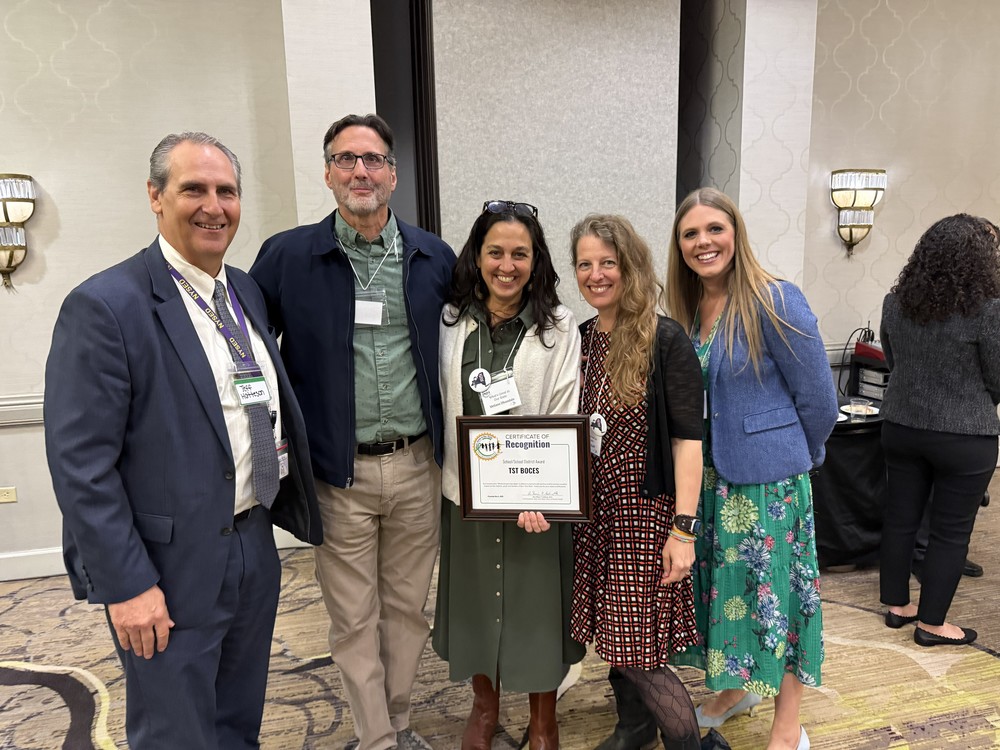
The TST School Health Systems team, composed of Dr. Melissa Dhundale and Jessica Hoff, PA-C, was honored on May 5, 2026, in Albany.
Joining them at the ceremony were Dr. Jeffrey Matteson, Senior Deputy Commissioner for Education Policy and former TST Superintendent, who played a key role in launching the School Health Systems CO-SER, as well as TST District Superintendent Lily Talcott and retired TST Assistant Superintendent David Barr.
For many families, accessing care can feel complicated and disconnected. Students may only see a provider once a year, communication between schools and healthcare providers can be limited, and support can take weeks or even months to reach a child who needs it. TST BOCES School Health Systems was designed to close those gaps.
“This recognition speaks to the incredible collaboration happening across our region,” said Lily Talcott. “Through this CO-SER, we are breaking down barriers that have historically made it difficult for children to access care, and for educators to connect to the healthcare providers supporting our children. What makes this work so powerful is that it brings people together, schools, healthcare providers, and families, around a shared goal of supporting the whole child.”
School Health Systems expands the traditional school medical model into a coordinated, team-based approach that connects educators, healthcare providers, and families. Instead of working in isolation, these partners collaborate to ensure students receive the right support at the right time.
The impact of this work is also gaining recognition beyond New York State. The School Health Systems model was recently published in a peer-reviewed medical journal article titled “Project TEACH School-Focused Consultation and Community Collaboration: A Multidisciplinary Pilot Intervention to Reduce Mental Health Disparities in Upstate, NY.” The article is part of a special issue focused on promoting mental health in school and community settings and highlights the collaborative, systems-based approach developed through TST BOCES.
As outlined in the recently published medical journal, the SHS team holds regular “Huddles,” where pediatricians, school staff, and mental health professionals come together to problem-solve in real time. The model also includes direct communication with primary care providers, 24/7 on-call medical support, care coordination, and access to psychiatric consultation when needed. Embedding this level of support within schools helps identify concerns earlier and respond more quickly.
The impact is both immediate and long term. Students receive more timely, coordinated care. Families feel more supported. Schools are better equipped to respond to increasingly complex needs. In many cases, students are connected to supports they may not have otherwise accessed, including mental health services identified during routine care. In fact, under this model, 27% of students receiving routine health exams were connected to mental health supports they would not have otherwise received.
This model also strengthens the support available to school staff while building a more sustainable system of care across the region. By streamlining communication and aligning systems, School Health Systems ensures schools are not navigating complex situations on their own.
For those leading the work, the recognition is meaningful, but it also reinforces the importance of continuing forward.
“We’re incredibly honored to receive this award,” said Dr. Melissa Dhundale, Medical Director of School Health Systems. “It reflects the trust and partnership we have built with schools, providers, and families across our region. It’s really a reflection of the collective effort behind this work and the relationships that make it possible.”
Jessica Hoff, PA-C, Director of Preventative Health Services, emphasized that the work is ongoing. “While this recognition means a great deal, we know the work is not finished,” Hoff said. “We are committed to continuing to grow this system so every child has access to the support they need, when they need it. That is what continues to move us forward.”
For TST BOCES, the recognition reflects something larger than a single program. It represents a shift toward a more connected, compassionate system where health, learning, and well being are treated as inseparable, and where every child has a stronger, more coordinated network of support to be able to grow and thrive.